

Ghatam, an earthen pot, is an Indian percussion instrument used mainly in Carnatic music. At the third edition of the History Literature Festival at Bangalore we were mesmerized by Sumana Chandrashekar playing the Ghatam. She is one among the few women Ghatam players in India.

The Pot: Ghatam is a clay pot, narrow at the neck and open at the top. It is widely used in all parts of India as a ‘useful pot to put things in’, a la Winnie the Pooh, mainly to cool water. It is commonly called ghada, matka in Rajasthan, noot in Kashmir, ghummat in Goa and Maharashtra, villu paatu in Tamilnadu and dhankul in Chhattisgarh.
Playing Ghatam: Ghatam is played with the fingers and the balls of the palm. Stroking the belly of the Ghatam, neck or upper rim, with different striking techniques produces different sounds.


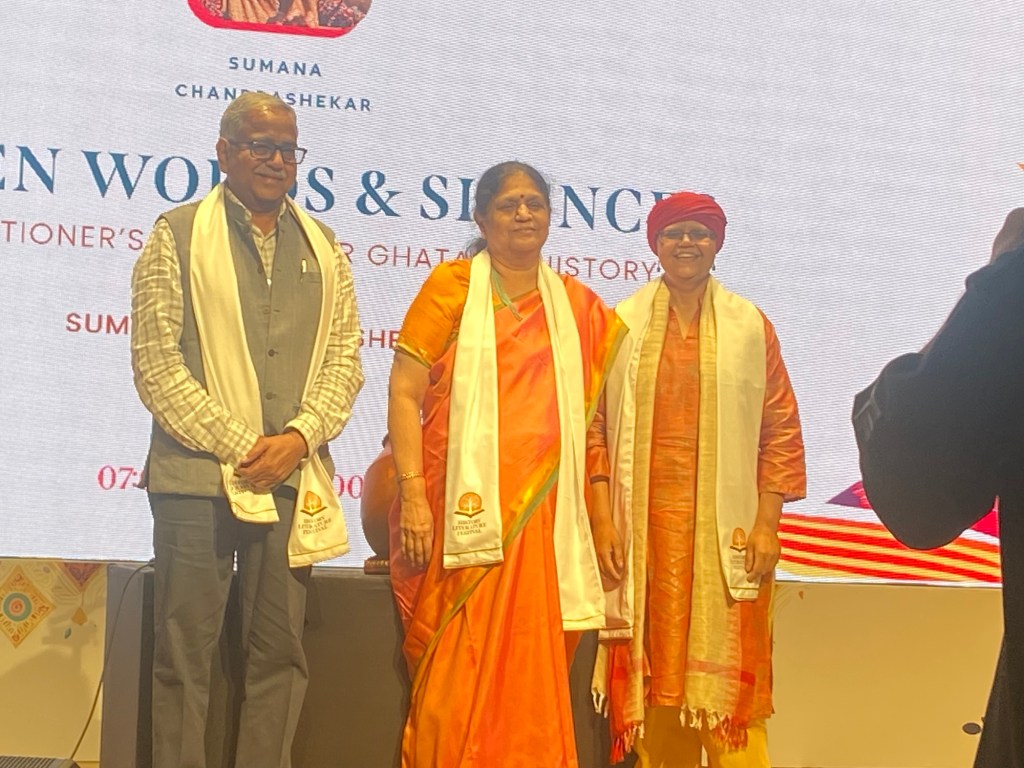
Craft of making Ghatam: There were three main centres for making the Ghatam, Devanahalli in Karnataka, Chennai and Manamadurai in Tamil Nadu. Only Manamadurai is still an active Center for making Ghatam. Devanahalli had a lake and a village of potters where the Kempegowda International Airport of Bangalore is situated now. The Chennai Centre has also dwindled. It is from Manamadurai that Sumana gets her customised Ghatam made. The two male potters seen on the right of the picture are no longer making Ghatam. The lady in the center and Ravi at the extreme left are the main potters who make the Ghatam for Sumana.

History: Charles Russel Day published a book titled ‘The music and musical instruments of Southern India and the Deccan in 1891. He had this to say about the Ghatam, ‘The Vina is the favourite instrument, and is generally accompanied by either a Mathala or Tabla, or else by a kind of earthen pot called Gatha, much like the ordinary “chatty,” which, in the hands of a skilful performer, is beaten with wonderful dexterity. … players manage to produce sounds of different pitch by striking it in different places. The performer usually sits cross-legged, and holds the gatha between his thighs, striking it with his finger tips, flat of his hand, or fleshy part of his wrist. Players upon the gatha display great dexterity.’ Herbert Arthur Popley in 1921 also mentioned the Ghatam in his book titled ‘The Music of India’.

Karnatakam (Kalki)
1936, Alangudi Ramachandran’s ad for ghatam
Kalki magazine
1950

Ghatam Sundaram lyer, Ghatam maestro wrote in the Journal of the Madras Music Academy in 1930: ‘In other thala instruments, good and proper musical sounds (can) be produced only in specified places (with) specific methods of fingering. In Ghata, wherever and in whatever manner you touch it, it can produce good musical sound… moreover the instrument resembles earth in its globular shape. Just as earth has got certain climatic conditions from the north pole to the south pole, the sound differs in various places in between the poles of the pot. Give me a pot cracked, but not broken, I will still find out its strong and resonant points and play all the beauty of the instrument without in the least spoiling the concert’.
The instrument was further popularised when Alangudi Ramachandran’s placed an advertisement for ghatam players in the Kalki magazine in 1950.
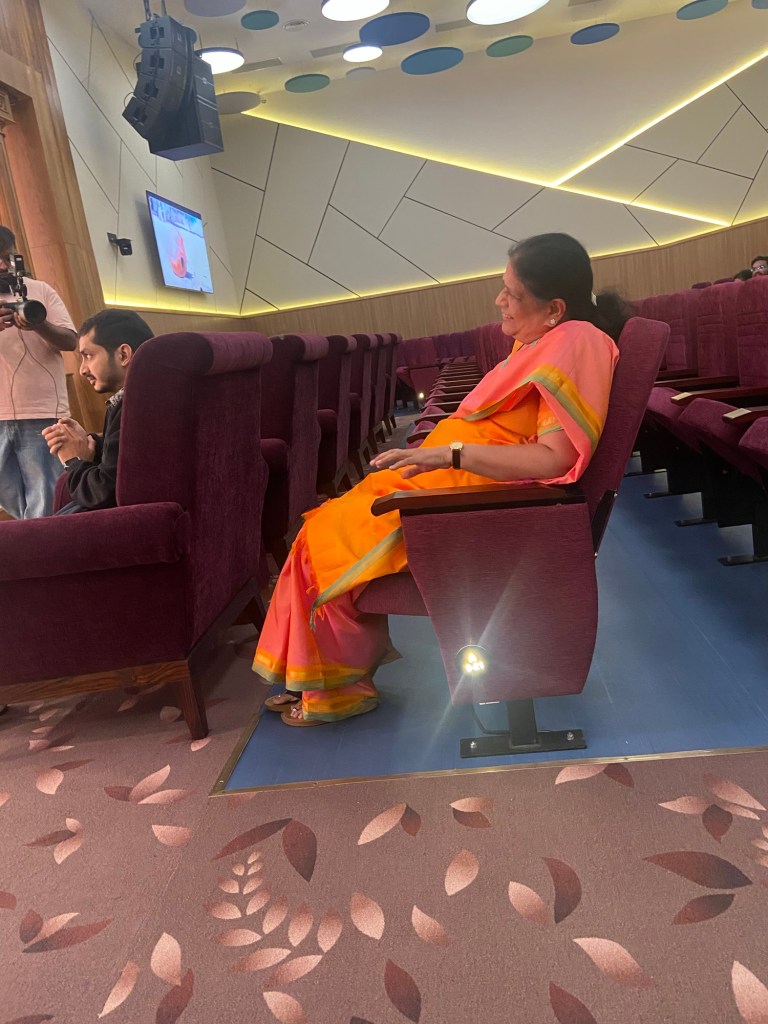
Women Ghatam Players: As described by Charles Russel Day, the manner of playing the Ghatam, ‘holding it between the thighs’ and pressing the mouth of the Ghatam to the bare belly, inhibited women from playing this instrument. Sumana’s guru Sukanya Ramgopal was one of the early women to enter this male dominated field of music. In Sukanya’s illustrious career, Sumana was the only female student of ghatam. We were lucky to have the guru and shishya together in the hall. She was sitting across the aisle from me. I noted her engrossed in the music with her eyes shut and keeping ‘taal’ with her fingers. I thought this lady really understands music and I took this photo. Little did I know that she was the guru of Sumana! Sukanya was the disciple and learnt the Ghatam from her guru Vikku Vinayakaram. She was clearly the only female student that her Guru ever trained.

Ghatam’s Rise to Fame: The Ghatam, as a musical instrument, conventionally occupied the fifth position in a Carnatic music concert. The first position went to the Violin, then the Vina, next Harmonium, Mridangam and fifth came the Ghatam. This was also reflected in the seating arrangement on stage. Ghatam was seen as incapable of producing complex rhythms and the Ghatam player was often invited to produce comic relief.
M S Subbulakshmi, a renowned Carnatic vocalist, collaborated with the Ghatam maestro Sri Vikku Vinayakaram. They performed together in the UN concert in 1966. This played a crucial role in popularizing the instrument and opened the doors to the Ghatam on the international stage. Sumana described the musical rhythm that was played at the concert. She explained how a few beats were left empty for Sri Vikku to fling the Ghatam in the air. Here is her demonstration of the same on video.
Caste: Someone in the audience asked why the Ghatam was played only by high caste persons. Sumana had an interesting explanation. In early times the Mridangam was not played by the higher caste as it was made with leather drumheads on both sides. The Ghatam made of clay, the earth, was a popular percussion instrument. Later when the mridangam gained popularity it was captured by the higher caste and so was the Ghatam!

 Unni-Verse