
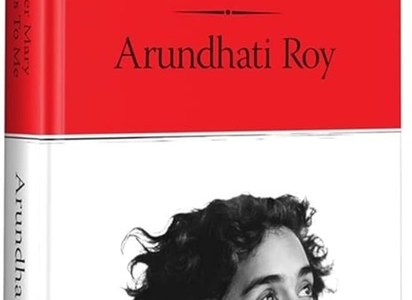

If there is one thing common between mother Mary Roy and daughter Arundhati Roy it is that both lived life on their own terms. And the book brings it out poignantly.
I waited for the cheaper Kindle edition, refusing to buy the expensive hard cover version. I have read her two earlier books of fiction. I loved ‘The God of Small Things’ and so did my Dad. He loved her repeated comment ‘dum dum’ and it was a standing joke or expression in the interaction between granddaughter and grandfather. My mother loved her little Malayalam limericks, the best being about the bird that sat on her fence. “Ende parambill thooralley, Chetende parambill thoorikko”. (Don’t shit in my farm, shit in the neighbouring brother’s farm). Later I read and wrote a review on my blog on her next novel ‘The Ministry of Utmost Happiness’. Like most reviewers I was disappointed with the book following ‘The God’! In the review I wrote, “Happiness” is quite bereft of humour (unlike The God) and is a somewhat dark vision of life around as seen by the author and recorded by the narrator. A lot of her views and description of the events that unfolded in India in that book are repeated in ‘Mother Mary’. But the narrative in the latest version is more mature.
The reviewers and my Malayali friends had vehemently opposing views on the book. One dominant view, apparently from people in and around the mother’s village, was that most of the description of her mother’s nature and the quarrels within the family were not true. The other view was that the rather difficult mother-daughter relationship described could very well be true. We do not know how relationships develop? To my surprise this no constituted a peripheral part of the novel. What I wanted to read about was the legal battle, as I describe below. But it was also a side story in the book.
Mary Roy had filed a case for her share of the property in 1960. This and the later failures were reported in several papers and women’s magazines at that time. It caught my attention even as a student in school and I curiously followed the case applauding loudly when she won in 1986.
The Syrian Christian community of Kerala followed the provisions of the Travancore Succession Act of 1916 and the Cochin Succession Act, 1921, while elsewhere in India the same community followed the Indian Succession Act of 1925 (Mary Roy – Wikipedia). Mary Roy was an icon who knowingly or unknowingly fought for the women’s right to inheritance of this community and successfully overturned this discriminatory Act. It was a long and protracted struggle. She filed a case against her brother in 1960. The lower court rejected it. She went on to file the case in the Supreme Court where finally the case was judged in her favour in 1986. The ruling was that the Travancore Christian Succession Act was invalid after 1951 and was superseded by the Indian Succession Act of 1925. The verdict was applicable retroactively. However, there was a long battle ahead. She had to file cases in the lower courts in Kerala multiple times. She finally got her rightful share in her parents’ property in 2010, half a century later!
I started reading the book in the hope of learning the details of what Mary Roy went through when she filed and lost the case so many times. I hoped to learn about the arguments that were made, what documents or evidence was presented. But there was hardly any information in the book on how the case was argued and how it was won. I was sorely disappointed.
The book is mainly about the journey of the author through her childhood, where the wayward behaviour of her mother is described. A famous dialogue in a Hindi movie that we quoted and laughed at repeatedly on various occasions was ‘Bina ‘dress ke aaga ye?(You arrived here without an address?) I remembered this when the villagers tell Arundhati, “Do you know what they call you? ‘Address illathu pillaru’– the children without an address”. It probably hurt her mother more than it hurt the author because they were too young to understand what it meant.
The book goes on to describe her life after gaining the architecture degree and straying into acting in the film Massey Saab. She and her friends led a hand-to-mouth existence, while she tried to hone her skills as a writer. Winning the Man Booker Prize for her first novel ‘The God of Small Things’ was a miracle she least expected. It took care of her finances for life.
What I liked best about her narrative was her approach to the fame that followed after winning the Booker. There was pressure on her to write more novels in a similar vein. She made an unprecedented amount of royalty money from that one book. She was ashamed and afraid that she would be trapped in a ‘gilded cage’. She ran from this trap. How many authors would do that? It showed that her character did not allow her to embrace stability. Every time a stable, or maybe a traditional life, loomed ahead, she ran!
She joined the Narmada Bachao Andolan on the periphery, meaning being the documenter of the movement. During her trips to the Narmada Valley she again reiterates her sense of remorse on any form of achievement. She states ‘Like many women, I became almost apologetic about myself and my so-called success’. At times ‘it seemed as though every tender moment in The God of Small Things had been traded in for a silver coin. And that if I wasn’t careful, I would turn into a cold silver figurine with a cold silver heart.’ Self effacing is what women in India do and she felt she did the same, ‘not claiming attention for oneself, retiring and modest’.
Some of her observations are brilliant like when John Berger listens to her writing and she thought he could have written a book called Ways of Listening. ‘He listened with his whole body. As though my words were rain, and he was the earth. He absorbed everything, gathered every drop, missed absolutely nothing. His listening eyes were lakes in the high mountains. It was love, there’s no other word for it. I don’t think that stillness, that quality of attention, is even possible in digital-age humans, who suckle on mobile phones from the moment they’re born. It’s a generational thing. Lost for ever, I believe.’
This is just a brief comment on what I liked and disliked about the book. The last observation about children of the digital age resonated with me. As a professor teaching under and postgraduate students I noted short attention span and dependence on ChatGPT and AI as endemic problems. I truly hope that her observation about the new generation, ‘lost for ever’, does not prove right.

 Unni-Verse
Good morning Jeemol, Merry Christmas. I took the freedom to share this blog with our community’s readers group.
LikeLike
Thanks Tulsi. Blog posts are meant to be read!
LikeLike