

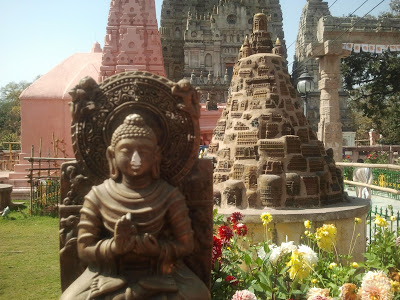
Bodh Gaya: In February 2012, we visited Bodh Gaya, the holy place where Bhagwan Buddha gained enlightenment. I had been there once before and was fascinated by the Bodhi Tree. The Bodhi Tree seemed a lot taller. And I did not remember the launch temple.
Bhagwan Buddha gained enlightenment under the Bodhi Tree, a Peepul Tree, early in the sixth century BC. In the third century AD, a king made a diamond throne under the Bodhi Tree to mark the place and event. In the sixth century AD Another king made a temple in front of the tree. It must have been a lot smaller than the temple standing there today!
The place emanates such a sense of peace and Tranquility. I love the place, never felt so peaceful in a long time. The Bodhi Tree is a large tall peepul Tree with a large golden throne below it. Many spots in the area were marked by various types of trees and temples where Buddha meditated after getting enlightenment. One stretch of land had some 30 odd lotus shaped stone structures to mark the steps of Buddha where he is said to have paced for a long time after he gained enlightenment. The entire place with all the small markings around the Bodhi Tree and the temple is kept clean. Lamp lighting, candles, or oil of any kind is not allowed in the area unlike the Hindu temples.
Vishnu Padh Temple: We went to the Vishnu Padh Temple in Gaya. A very interesting story revolves around this temple. River Phalgu flowed here and this is where the Hindus do Pitra Paksh and immersion of the ashes after the death of the father and other male ancesters. The story goes that Lord Rama, Sita and Lakshman came to Gaya to do Pitra Paksh of Raja Dashrath, Ram‘s father. While Ram and Laxman went to get the things required for the ceremony, there was an Akashvani (voice from above) that this was the best time to do the ‘visarjan’ of the ashes. Sita was alone carrying the ‘pinda’. Another story states that king Dashrath appeared out of the water and asked Sita for the Pinda. Sita took the ashes to the river but she needed witnesses. She asked a passing cow, a Thulasi plant, the river, a Brahmin and the Akshaya Vatam (meaning “the indestructible banyan tree”) to be witnesses. Sitaji performed the visarjan, dipping the ashes in the river.
When Lord Rama and Lakshman returned and saw what had been done, they were upset. Sita asked the witnesses to testify, but to her dismay, they refused to acknowledge the visarjan. Sita was furious and she cursed the river and said that the river would disappear and only during the rains would there be water in this river. And till date, the River Phalgu has no water above and water flows below the ground. If holes are dug in the bed of the river the water will appear.
After our visit to Vishnu Padh Temple, we called my mother-in-law as that day was also Mahashivratri, which happened to be my father-in-law‘s birthday. She was very happy and said that if she had known the Puja could have been done for the departed male ancestors once and for all in Vishnu Padh. Apparently, then ‘Shraadh’ Puja does not have to be performed year every year.
Vishnu Padh itself is an interesting temple where the deity is a 40 cm long footprint of Lord Vishnu. This is said to be the spot where Lord Vishnu subdued the demon Gayasura by pressing his right foot on his head leaving this imprint. Of course all of this we discovered later from the priest who followed us around and from a book, we bought.
Under the Bodhi Tree, I wished for the Institute’s good future and at Vishnu Padh I prayed for Papa and all of us. A Holy Day indeed, peaceful and happy we returned safely in good spirits. A mission fulfilled, more successful than expected.


